
SERVING NORCAL SINCE 2008
Garage Floor Epoxy Installation
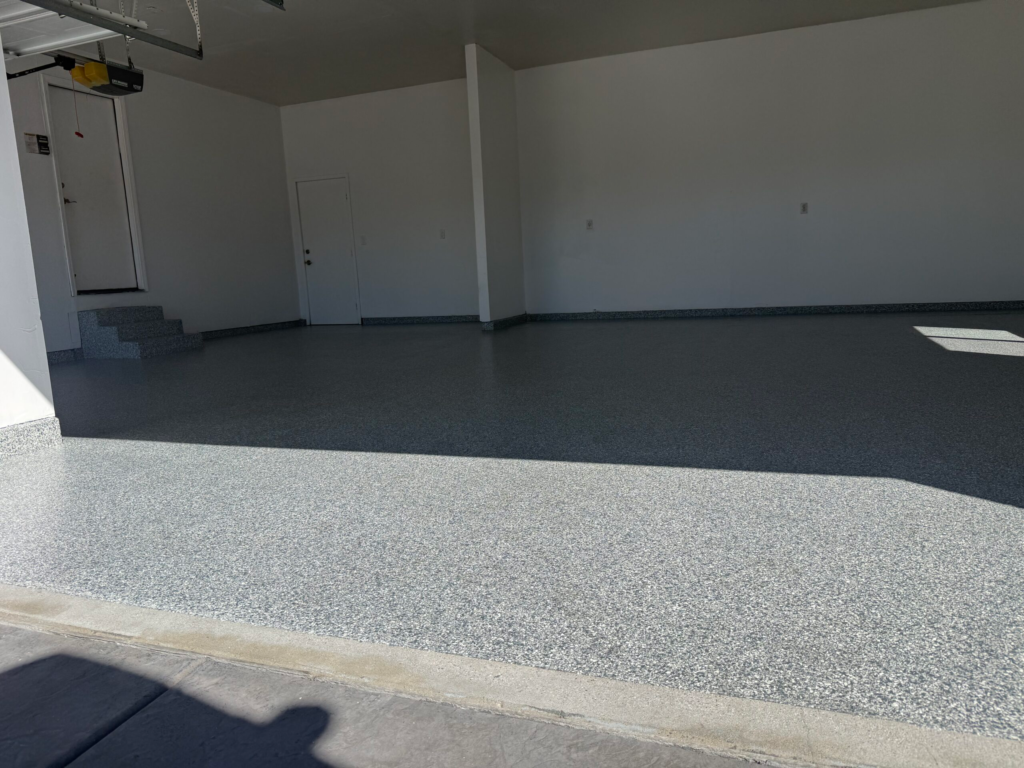
Epoxy Armor Systems provides garage floor epoxy installation for homeowners in Rancho Cordova, Sacramento, and the surrounding areas across Northern California. We diamond grind your concrete, fix the cracks, apply a colored basecoat with a full broadcast of vinyl flake, and seal it with polyaspartic clear topcoat that is UV stable. Most garages take 2 days. You can walk on the floor after 24 hours and park on it after 48.
Concrete ground smooth and cracks repaired
Epoxy base, colored flake, and a clear polyaspartic topcoat
Walk on it in 24 hours, park on it in 48
Limited Lifetime Warranty

Garage floors take a beating in Northern California. Summer days often top 100 degrees, and hot tires can pull up a weak coating. If your garage door stays open, the afternoon sun hits the floor too. That’s why we seal every floor with polyaspartic topcoat that is UV stable. Under it, your floor sticks tight to the concrete, hides dust, gives your shoes grip, and cleans up with a mop.
Our two man crews handle your job from start to finish. Every two man crew has a crew lead that has been with us at least 5 years, and several have been here 10 to 15. We're a California Licensed Epoxy Floor Contractor (#990361), and our epoxy floors come with a Limited Lifetime Warranty.

Call (530) 677-7303 for a quote. Tell us how you use your garage, and we'll explain which system fits and why. We can put a quote together by phone, by email, or at an on-site estimate.
Call (530) 677-7303Our Garage Floor Epoxy Installation Process
Here’s how garage floor epoxy installation works, from your first call to the day you park on it. Your crew grinds the concrete, repairs the cracks, vacuums floor until dust free, lays the base coat and broadcasts the flake, and seals it with a clear topcoat. Then the floor cures, which means the coating hardens all the way. Most garages take 2 days of work, plus the cure time.
Booking the job
Once you've picked a color and said yes to the quote, we confirm the job and give you an arrival window. We send the schedule to our crew, so our guys who show up know your job before they pull in.
Your crew
Each crew has a crew lead and a helper. The crew lead drives the van, picks up the product, and installs your floor. Every crew lead has been with us at least 5 years, and several have been here 10 to 15. That means the installer on your floor has done a lot of garages.
Before we arrive
Clear the garage floor completely. Move cars, storage bins, boxes, bikes, and anything else that sits on the concrete. If you're not sure what has to go, ask when we confirm the job.
Here's the work itself, in order:
Grind the concrete
We diamond grind the whole garage floor. This is what lets the base coat bond. It also takes off old paint, worn concrete, and much of the surface staining.
Repair the cracks
We fill hairline cracks so they don't show through the finished floor. Your job includes 50 feet of hairline crack repair, and we'll tell you up front if your floor needs more than that.
Coat the stem walls
Stem walls are the short concrete walls that run along the bottom edges of many garages. We coat stem walls that are 6 inches tall or under, so the floor and the edges match.
Lay the epoxy base coat and broadcast the flake
To broadcast the flake means to toss the colored chips by hand across the wet base coat. We throw the flake in until the base coat stops absorbing it. That full coverage gives you the even look, the grip under your shoes, and a floor that hides dust.
Seal it with polyaspartic
A clear polyaspartic topcoat that is UV stable goes over the flake to lock it in and take the daily wear.
We use Citadel products only. Our crews know how they handle and cure because they work with the same products on every job.
When the floor is done, the crew lead walks it with you and collects payment at completion. You don't pay the balance until you've seen the finished floor.
Cure times
You can walk on the floor after 24 hours. Wait 48 hours before you bring back cars and heavy items like tool chests, freezers, or gym equipment. Park on the driveway or street for a couple of days, and keep anything heavy out until the 48 hours are up. Waiting the full time is part of the job, not a delay. The cure is the last step, and it matters as much as the first.
Our Limited Lifetime Warranty
Our garage floors come with a Limited Lifetime Warranty, and "limited lifetime" means 15 years of full coverage. Here's how it works:
First 15 years: fixed 100% free
If the coating fails because of lack of prep work or product failure, such as peeling off the concrete, we fix it at no cost to you.
After 15 years: prorated repairs
The warranty lasts as long as you own the home. Repairs are prorated, and you pay time and materials only.
That's one more reason we grind every floor. A coating that's bonded to clean, solid concrete is a coating we're glad to stand behind.
What Goes Into Your Floor: Epoxy Base, Flake, and a Polyaspartic Topcoat
Every garage floor we install is built in three layers, and the top layer is always polyaspartic. You don't have to pick a product and hope it's right. Each layer does the job it's best at, and the system works because they work together.
Layer 1: Epoxy base coat
Epoxy is a thick, hard coating that soaks into ground concrete and bonds well. It builds a solid base for everything above it.
Layer 2: Flake
We broadcast colored chips by hand across the wet base coat. The flake gives your floor its color, adds grip under your shoes, and hides dust and small marks.
Layer 3: Polyaspartic topcoat
This clear layer goes over the flake, locks it in, and takes the daily wear. Polyaspartic cures faster than epoxy and is UV stable. Some epoxies can turn slightly yellow over time in direct sun, so we don't leave epoxy as the top layer. In a garage where the door stays open and afternoon sun hits the floor, that matters.
Here's why we put polyaspartic on every floor:
It is UV stable. Your flake color looks the same years from now, not yellowed.
It cures faster. That helps keep your wait to 24 hours for walking and 48 hours for parking.
It takes the wear. Tires turn on it, bins get dragged across it, and tool chests roll over it. The topcoat is the layer that handles all of that.
The only choice left to you is the look. You pick the flake color, and we help with that part when you call. If you're considering a metallic finish instead of flake, that's built differently.
None of these layers works on an unprepared slab. We grind every floor first, and the section on surface prep below explains why. If you're comparing our quote to another company's, the cost section below lists what to ask.
Garage Floors We've Installed




How Much Does Garage Floor Epoxy Installation Cost?
We quote every garage individually, because the price follows a few things:
Garage size. More square feet means more material and more time.
Crack repair. Your job includes 50 feet of hairline crack repair. A floor with more cracks than that adds to the labor.
Material and coats. The number of layers and the materials in each one affect the material side of a quote.
Every quote from us includes:
Diamond grinding of the whole floor
50 feet of hairline crack repair
Stem walls coated up to 6 inches tall
Epoxy base coat
Full flake broadcast
Clear polyaspartic topcoat
Our Limited Lifetime Warranty
A walk-through with your crew lead, with payment at completion
Comparing quotes? Ask each company these questions:
What material goes in each layer: the base coat, the flake, and the topcoat?
How many coats will I get?
Is diamond grinding included?
Is crack repair included, and how much?
Two quotes that both say “epoxy floor” can be very different floors. A lower price may leave out grinding, crack repair, or the clear topcoat. Every quote from us includes all three, so you can compare line by line.
We put quotes together by phone, by email, or at an on-site estimate. Call (530) 677-7303 to get started.
Call (530) 677-7303Signs Your Garage Floor Is a Good Candidate for Coating
Most garage floors are good candidates for a coating, even ones that look rough today. If the slab is solid and the pieces sit level with each other, it can take a coating. Stains, small cracks, and worn spots aren't deal breakers. Grinding and repair are there to fix those things.
Here are signs your floor is ready:
The concrete is solid. It may be dull, dusty, or stained, but it isn't crumbling or breaking off in chunks.
The cracks are thin. Hairline cracks are normal in garage slabs. We repair them before we coat, so they don't stop the job.
Both sides of each crack sit at the same height. If you can roll a creeper or a shop cart across a crack without a bump, that's a good sign.
You have oil drips and tire marks. They look bad, but they're on the surface. Grinding takes off the worn top layer and much of the staining with it.
There's old paint or a peeling coating. That doesn't rule you out. It gets ground off before anything new goes down.
You want a floor that's easier to live with. A flake floor hides dust, gives your shoes some grip, and cleans up with a mop.
Some floors need something else first. We'd rather tell you that now than after you've picked a color.
Sections of the slab are sinking or lifting. If one side of a crack sits higher than the other, the concrete itself is moving. A coating follows the shape of the slab. It won't level it. A concrete contractor should look at that first.
Cracks keep getting wider. A crack that grows from season to season points to movement under the slab. Fix that at the source before any coating goes on.
The concrete is brand new. Fresh slabs need time to cure before they're coated. If your garage was just poured, ask your builder when the work was done and tell us when you call.
You see damp spots that come and go. This doesn't mean you can't coat. It means the slab should be checked first. Our moisture testing and mitigation service is built for that step.
There are also good reasons to wait, or to skip a coating altogether:
A remodel is coming. If contractors will haul drywall, lumber, or tools through your garage soon, have the floor done after that work wraps up.
You plan to tear out or replace the slab. Don't coat concrete that's on its way out.
You're selling a rental next month and just want it to look clean. A good sweep and a degreaser might be all you need. A coated floor is built to last for years, so it makes the most sense when you'll be the one using it.
We do turn down some jobs. If your floor isn't a fit right now, we'll tell you why and what would need to happen first. Not sure which list your garage falls on? Describe what you're seeing when you call. Cracks, stains, old paint, and new concrete are all things we can talk through before anyone comes out.
When a Full Epoxy Installation Is Not the Right Fix
A full flake floor is a great fit for most home garages, but it isn't the answer to every floor problem. Sometimes you need less than a full system. Sometimes you need more. Here's how to tell, so you don't pay for the wrong job.
You might need less in a few cases:
You only care about one crack. Say the floor looks fine to you, but one crack catches the wheels of your tool chest. If the look of the floor doesn't bother you, a crack fix on its own may be all you need. Our concrete crack and joint repair service handles that without coating the whole garage.
Your coated floor is still holding on. If the coating is bonded but looks dull or scuffed, it may only need a new topcoat, not a full redo. That's a recoat job.
You just want it clean. If you're happy with bare concrete and only want the oil spots gone, a good degreaser and a stiff brush can get you most of the way there. You can handle that yourself on a weekend.
Some spaces need more than a standard garage system. A garage floor is built for cars, foot traffic, storage, and the usual weekend projects. Some spaces work much harder than that:
It's really a shop or a business. Forklifts, pallet jacks, heavy machines, and daily traffic call for a heavier build. Our commercial epoxy flooring and industrial and warehouse epoxy floors are made for that kind of use, and one of our crew leads handles our commercial and specialty work.
The floor gets hosed down often. Think dog grooming, a wash bay, or a space where water hits the walls. A cove base can help here. A cove base is a curved strip of coating that runs from the floor a few inches up the wall, so there's no seam for water and dirt to sit in.
Slips are your main worry. If the floor stays wet from a pool, a wash area, or a sloped entry, grip matters more than looks. Our anti-slip floor coatings add texture so your shoes hold better.
None of this means a coated floor is a bad idea for those spaces. It means the system should match the work the floor does. A home garage floor laid in a busy shop is the wrong tool for the job, the same way a warehouse floor in a two car garage is more than most people need.
If you're between two of these options, that's normal. Tell us how you use the space, what bothers you about the floor today, and what you want it to do better. We'll tell you plainly whether a full installation, a smaller repair, or a different system makes more sense. If the honest answer is that you don't need us yet, we'll tell you that too.
Why Surface Prep Determines How Long the Coating Lasts
An epoxy coating is only as strong as its grip on the concrete, and that grip is set during prep, before any color goes down. When prep is done right, the floor is built to last for years. When it's rushed, even a strong product doesn't have much to hold on to.
It helps to know what the coating does. It doesn't hold up your car. The slab does that. The coating's job is to stay stuck to the slab while tires turn on it, warm tires park on it, and bins and tool chests get dragged across it. That's a lot to ask of a thin layer, and it can only do it if it's bonded to clean, solid concrete.
Here's what prep has to deal with on a typical garage floor:
The top skin of the slab. When concrete is poured and smoothed, the very top can end up weaker and slicker than the concrete below it. A coating that only grabs that skin is only as strong as the skin. Grinding takes it off so the base coat sits on the solid concrete underneath.
Old paint or coatings. If a new coat goes on top of an old one, the new floor depends on how well the old one is still holding. Grinding it off means your new floor starts fresh.
Oil and grime. Drips that have soaked into the surface can keep the base coat from touching clean concrete. Taking the top layer down removes much of that.
Cracks. We fill them before coating, so the base coat goes over one smooth surface.
Edges. The line where the floor meets the wall is easy to rush. Coating the stem walls along with the floor keeps those edges tight and matching.
You may hear about acid etching. It's another way to rough up concrete, and it's common with store-bought kits. An acid wash changes the surface with a chemical. Grinding takes the floor down to fresh concrete you can see and feel. We grind every floor because it lets us check the surface with our own eyes and hands before we coat.
Prep matters even more because a garage floor is built in layers. The polyaspartic topcoat holds the flake. The flake sits in the epoxy base coat. The base coat holds on to the concrete. Each layer leans on the one below it, so the whole floor comes back to that first bond. A great topcoat over a weak base is still a weak floor. That's why we don't treat prep as the warm-up before the real work. It is the real work.
You won't see prep when you look at the finished floor. You'll see it years later. The flake will still be in place, the edges will still be tight, and the spot by the door where your tires turn every day will still look like the rest of the floor. That's what you're paying for when a quote includes full grinding and repair.
Want to know how your floor would be prepped before you pick a color? Ask when you call. We can tell you what our crew will do to your slab and why, by phone, by email, or during an on-site estimate.
Frequently Asked Questions About Garage Floor Epoxy Installation
How long does garage floor epoxy installation take?
Garage floor epoxy installation takes 2 days for most garages, followed by the cure. The crew lead handles all four steps: grinding, crack repair, coating, and curing, and stays on your job from start to finish. You can walk on the floor after 24 hours. Wait 48 hours before parking cars or rolling heavy items like tool chests or freezers back in. Plan to use your driveway or street for a couple of days so the coating has time to fully bond.
How much does garage floor epoxy cost?
We quote every garage individually, because garage floor epoxy installation depends on garage size, how much crack repair the floor needs beyond the 50 feet included, and the materials and coats in the system. Every quote includes full diamond grinding, stem walls up to 6 inches tall, flake, a polyaspartic topcoat, and our Limited Lifetime Warranty. We can quote by phone, by email, or at an on-site estimate. Call (530) 677-7303.
Will an epoxy garage floor turn yellow in the sun?
Some epoxies can turn slightly yellow over time in direct sun, which is why every floor we install gets a clear polyaspartic topcoat. Polyaspartic is UV stable, so your flake color stays true even if your garage door is open most of the day or the floor gets some afternoon sun.
Can you coat a garage floor that already has oil stains or old paint on it?
Yes, oil drips, tire marks, and old peeling paint do not disqualify your floor. Diamond grinding removes the worn top layer of concrete along with much of that surface staining and any leftover paint. That gets the slab down to clean, solid concrete so the new coating has something solid to bond to.
Do I need to do anything to my garage before the crew shows up?
Yes, clear the floor completely before your scheduled arrival window. Move cars, storage bins, bikes, and anything else sitting on the concrete out of the garage. If you're unsure what needs to move, ask when your job is confirmed so nothing holds up the crew once they arrive.
What if my garage floor has cracks that keep getting bigger?
A crack that keeps widening from season to season usually means the concrete underneath is still moving, not just settled. That kind of movement is worth having checked by a concrete contractor before any coating goes down. Hairline cracks that stay the same size are normal and get repaired as part of a standard installation.
What does your garage floor warranty cover?
Our Limited Lifetime Warranty covers failures due to lack of prep work or product failure, such as the coating peeling off the concrete. For the first 15 years, we fix those failures 100% free. After 15 years, the warranty lasts as long as you own the home, but repairs are prorated and you pay time and materials only. "Limited lifetime" means 15 years of full coverage.
Can I install a garage floor coating myself?
You can, but the result depends on prep. Store-bought kits commonly rely on acid etching, which changes the surface with a chemical. We diamond grind every floor, which takes it down to fresh concrete we can see and feel before we coat. That prep, along with the materials in each layer, is the biggest difference between a kit and a professionally installed floor.